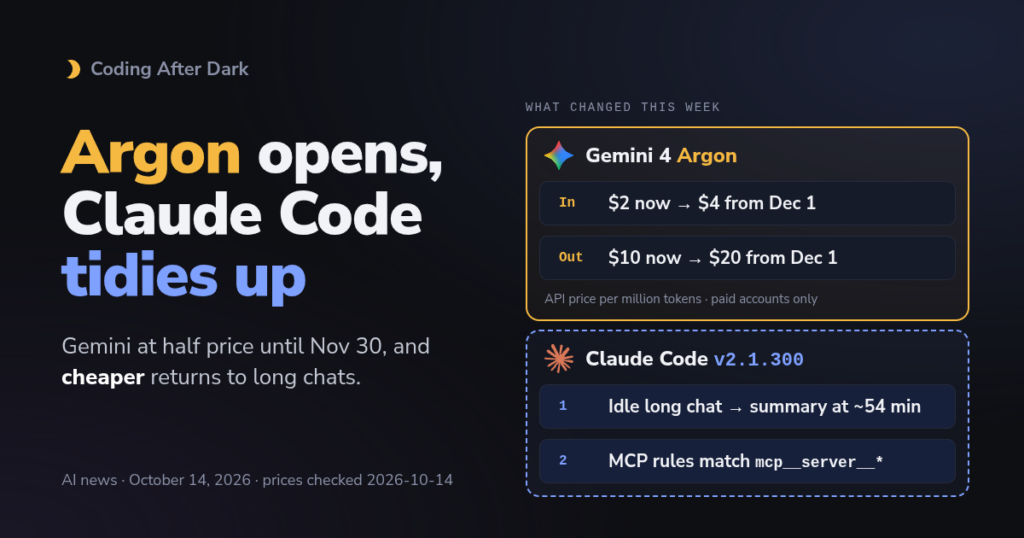
Two bits of news from this week. Google’s new top model, Gemini 4 Argon, went from an invite-only test to something anyone paying can use. And Claude Code shipped two updates on the same day with a few quiet changes that save money and close a security gap.
Neither story is flashy, but both affect what you pay and how safe your tools are. This post covers who can use Argon and what it costs, what the early doubts are, and what the Claude Code changes mean for you.
What is Gemini 4 Argon?
Argon is Google’s new flagship AI model, aimed at long, multi-step work. In Google’s introduction post the company names coding, finance, law, cybersecurity and science. Google also says it answers “more directly with less hedging” and repeats itself less.
News coverage says it was first announced on September 30, 2026. At that point only a small group got it: cybersecurity defenders in Google’s Fairwind Program, Google’s own teams and trusted testers. On October 13 Google opened it to paying users. Google’s introduction post now carries the October 13 date too, probably because it was updated for the wider launch.
Who can use it?
It depends on how you use Google’s AI. A subscription to the Gemini app and paying for the API are separate things. The API is the direct connection developers use, billed per token (roughly per word).
| Where | Who gets Argon |
|---|---|
| Gemini app and AI Mode in Search | Google AI Pro and Ultra subscribers |
| Google Antigravity (Google’s coding agent) | Ultra subscribers only |
| Gemini API (AI Studio, Google Cloud) | Paid API accounts. Not the free tier, and not included with AI Pro |
| Fairwind Program | Vetted cyber defenders, with fewer safety limits |
What does it cost?
For developers, Argon launches at half price. The Gemini API pricing page shows the jump on December 1:
| Per million tokens | Until Nov 30, 2026 | From Dec 1, 2026 |
|---|---|---|
| Input (what you send) | $2 | $4 |
| Output (what it writes, including its “thinking”) | $10 | $20 |
| Cached input | $0.10 | $0.20 |
Two things are worth knowing. First, output costs five times as much as input, and the model’s hidden “thinking” counts as output. A model that thinks a lot can cost more than the input price suggests. Second, cached input is 95% off. Caching means the AI reuses work on text it has already read. Argon only does this automatically, so you can’t set it up yourself. Our prompt caching explainer covers how to get the most from it.
Google also lists a “1M unified input-output token limit”. That’s one shared budget for what you send and what it writes back, not a million of each.
Is it actually better?
This is where Google’s claims and outside evidence come apart, so here’s who says what.
Google says Argon ranks #1 on the Vals Index (a combined test hosted by vals.ai), scores 87% on ERQA (a test of reasoning about the physical world) and lets prompt-injection attacks succeed only 0.7% of the time on Gray Swan’s test. Google doesn’t say who ran these tests. Inside Google, it says code submissions through Antigravity rose more than 35% and rollbacks fell by nearly a third.
Outside reports are more cautious. According to Bloomberg, as summarized by Android Headlines, several Google employees with early access said Argon “crushes standardized benchmarks” but struggles with real-world coding and front-end web design. Critics call this “benchmaxxing”, meaning a model trained to pass tests rather than handle messy real work. Edwin Chen of Surge AI compared it to “a student getting top SAT scores without developing actual real-world skills.” Google denies that Argon underperforms at coding.
Think of it like a new car that tops every lap-time chart, while a few test drivers say it’s awkward in city traffic. Until lots of people have driven it, we don’t know which story is true. Almost nobody outside Google could use Argon before October 13, so real hands-on reviews are only starting now.
What changed in Claude Code?
Claude Code is Anthropic’s coding assistant that runs in your terminal. Versions 2.1.299 and 2.1.300 both came out on October 14, 2026, with 190 bug fixes between them (changelog, checked 2026-10-14). Three changes stand out.
It tidies up long chats you walk away from
Claude Code keeps a prompt cache: a short-term memory of your conversation on Anthropic’s side that makes resending it cheap. It lasts about an hour. If you leave a very long chat and come back after the cache expires, the whole thing gets reprocessed at full price.
Now, when a chat of 200,000+ tokens sits idle for about 54 minutes, Claude Code compacts it (writes a summary) just before the cache runs out. Your next message starts from the short summary instead of the whole long history.
Picture leaving a 300-page draft on a colleague’s desk. Just before they’d forget it, they write a two-page summary. When you come back, they read the summary, not the whole stack.
The trade-off: a summary can lose details from early in the chat. To turn it off, add this to your settings.json (needs v2.1.290 or later):
{ "idleCompaction": false }MCP permissions now match names exactly
MCP (Model Context Protocol) is the standard way to plug outside tools into an AI, like your calendar or a database. Each tool comes from a “server” with a name, and you can tell Claude Code which servers it may use without asking.
Before this update, a rule allowing a server named a also allowed servers named a__b or a_. So a server whose name happened to start like a trusted one got the same trust. Now a rule only covers the server it names. The new way to write it:
mcp__<server>__*That’s good for safety, but check your old rules. Any rule that was quietly covering a second server won’t anymore.
Hook rewrites get checked too
Hooks are your own small scripts that run at set moments, like just before Claude uses a tool. A hook can rewrite what Claude is about to do. That rewrite is now checked as strictly as Claude’s own actions: unknown fields are dropped, and anything the tool rejects is blocked. Hooks that check your prompt also now run before a slash command expands, so blocking the prompt also stops any commands inside it.
Smaller items
- Background commands stop on exit. Anything still running 1.5 seconds after you quit gets force-killed.
- Path-only file mentions. A new opt-in setting,
CLAUDE_CODE_DISABLE_FILE_MENTIONS, makes@filesend just the path, and Claude reads the file itself. - Claude in Slack can now answer in Slack Connect channels shared with other companies. It’s off by default; an admin turns it on.
What to watch out for
- The Argon discount ends November 30. Budget at $4 / $20, not $2 / $10.
- A Pro subscription doesn’t include the API. The app and the API are billed separately.
- Most Argon numbers come from Google. The main outside signal so far is one secondhand report. Give it a few weeks.
- Idle compaction is a summary. If you need exact details from early in a long chat, turn it off.
- Old MCP rules may stop matching. Check them after you update.
- Claude Code updates almost daily. Everything here is as of October 14, 2026.
After After Dark To Try
- Check your MCP allow rules. Open your Claude Code settings and look for rules starting with
mcp__. Make sure each one names the whole server, likemcp__github__*. - Decide on idle compaction. If you often leave long sessions open over lunch, leave it on and watch your usage. If you need exact history, add
"idleCompaction": false. - Price one real task at both Argon rates. If you use the Gemini API, take a typical job, count its input and output tokens, and work out the cost at $2 / $10 and at $4 / $20. That tells you whether December’s bill will surprise you.
Sources
Official (primary sources)
- Google: Introducing Gemini 4 Argon. Who gets access, price footnote, token limit, Google’s benchmark claims. Opened 2026-10-14.
- Google: Gemini 4 Argon is now available in the Gemini app. October 13 launch for AI Pro and Ultra. Opened 2026-10-14.
- Gemini API pricing. Intro and later prices, caching price, paid tier only. Opened 2026-10-14.
- Claude Code changelog. Every Claude Code change in this post (versions 2.1.299 and 2.1.300). Opened 2026-10-14.
Independent tests
- No independent hands-on tests of Argon were available as of 2026-10-14.
News and explainers
- Android Headlines: the Gemini 4 Argon benchmark debate. Summary of Bloomberg’s report and Google’s response. Opened 2026-10-14.
- Android Police: Gemini 4 Argon for Pro and Ultra subscribers. Reviewer not seeing it yet. Not opened; seen in search results only.
- Let’s Data Science: Google releases Gemini 4 Argon to cyber defenders. The September 30 Fairwind launch. Not opened; seen in search results only.
- Coding After Dark: Prompt caching in plain English. Background on caching. Our own post.