For years, Meta was the big AI company that gave its models away. Its Llama models could be downloaded by anyone and run on your own computer. A lot of the “run AI at home” world was built on them.
Today Meta launched Muse Wonder and Muse Wonder Full, which it calls “our most capable models to date.” You can use them. You can’t download them.
That makes them closed models. Here’s what that means, why Meta might be doing it, and what changes if you’re a developer.
What Meta announced
- Muse Wonder is available now to developers through the Meta Model API (the way programs talk to Meta’s AI directly) and through Muse Code, Meta’s coding agent. An agent is AI that works through a task step by step on its own.
- Muse Wonder Full, the bigger version, is only for Muse Code subscribers. TechCrunch reports it isn’t offered through the API at all.
- Both will come to Muse, Meta’s personal assistant app, “soon”, starting with paying subscribers.
Meta says the models are built for agentic tasks: long jobs like reviewing a lease, handling an insurance claim, or building an app. It highlights two features:
- Active Memory: remembering useful details about you across conversations.
- Active Focus: sticking with a goal after something goes wrong, trying another approach, and asking before doing anything important.
How good is it? Meta says Muse Wonder is “state-of-the-art” on agentic tasks. TechCrunch reports that Meta’s model card puts it level with Anthropic’s Fable 5.1 and OpenAI’s GPT-6 Astra, and ahead of them on a memory test called MemoryBench. All of that is Meta’s own testing. No independent results are out yet. Treat it as a claim until someone else checks.
What does it cost? TechCrunch reports $4 per million input tokens and $20 per million output tokens on the API (unconfirmed: Meta’s developer page didn’t list a price when we checked on 2026-10-12). That’s the same price as Anthropic’s Opus 5.5. Reports of the app and Muse Code subscription prices vary, so we’re leaving them out until Meta publishes them.
What does “closed model” actually mean?
An AI model is, at its core, a huge file of numbers called weights. Training a model means adjusting billions of those numbers until the model gets good at predicting text. The weights are the model. Whoever has the file can run it.
So the real question is: who gets the file?
Think of it like food.
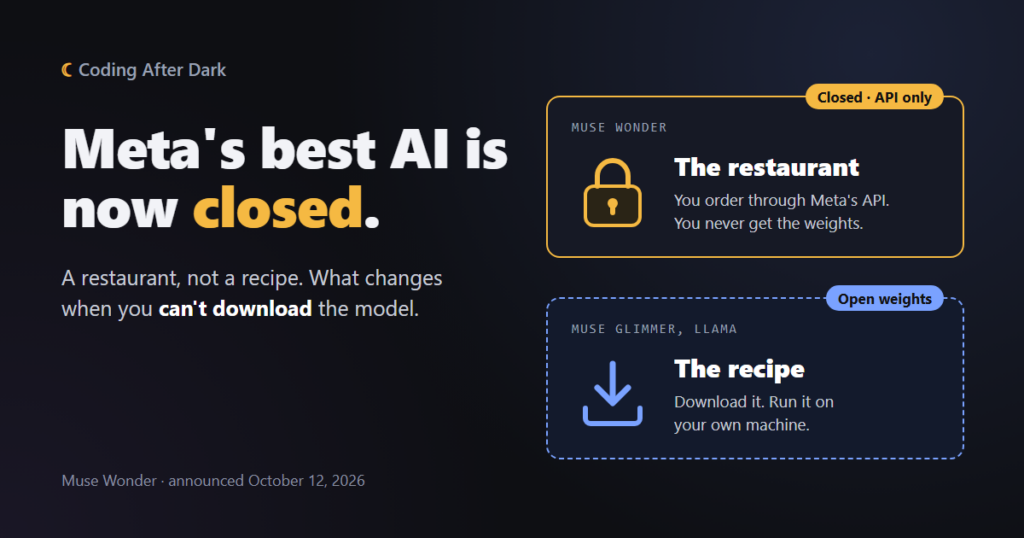
- A closed model is a restaurant. You order, you eat, you pay. You never see the kitchen or the recipe. The restaurant can change the dish, raise the price, or close on Tuesdays. Muse Wonder, ChatGPT’s models, Claude and Gemini all work this way.
- An open-weight model is a recipe you take home. You can cook it in your own kitchen, tweak it, and serve it to friends. You still don’t know exactly how the chef invented it. Llama, and Meta’s smaller Muse Glimmer, work this way.
- Truly open source would be the recipe plus where every ingredient came from: the training data and the method. Very few big models go that far. Analysts point out Meta’s open releases share the weights but not the training data.
People often say “open source” when they mean “open weights”. The difference matters, but for most developers the practical question is simpler: can I download it and run it myself, or not? For Muse Wonder, the answer is no. Meta’s posts list only the API and subscriptions, and say nothing about downloadable weights.
Wait, isn’t Meta the “open” company?
It was. Here’s how that changed this year:
| When | What Meta released | Open or closed? |
|---|---|---|
| 2023 to 2025 | Llama models | Open weights, under Meta’s own licence with some limits |
| April 8, 2026 | Muse Spark, the first model from Meta Superintelligence Labs | Closed |
| August 5, 2026 | Muse Spark 1.2 and the Muse Code agent | Closed |
| August 10, 2026 | Muse Glimmer, a smaller 30-billion-parameter model | Open weights, Apache 2.0 licence, on Hugging Face |
| October 12, 2026 | Muse Wonder and Muse Wonder Full | Closed (API and subscriptions only) |
Sources: Meta’s announcements, Meta’s developer site, and Futurum Group’s analysis.
So Meta now runs a two-track plan: small models open, the most powerful ones closed. Meta’s chief AI officer, Alexandr Wang, has also said Meta will release “an open weight version of Muse Spark 1.2” (as reported by Futurum). Earlier this year, MediaPost reported Meta’s plan to release new models closed first, partly to manage safety risks.
That last point is Meta’s main public reason. Its announcement says the Wonder models were trained to refuse clearly harmful requests and to protect private information. When a model is closed, the company can keep those guardrails in place and change them later. Once weights are downloaded, nobody can take them back.
The other reason is business. Meta has said its AI spending could reach $145 billion this year. Closed models are much easier to charge for.
What it means for developers
If you build apps, scripts or tools on top of AI, closed versus open changes a lot in practice.
What you give up
- You can’t run it yourself. No running it on your laptop, on your company’s own servers, or offline. Every request goes over the internet to Meta.
- Your data goes to Meta. Whatever your app sends, Meta’s servers see. Read the API’s data terms before you send anything private, especially customer or company data. Futurum reports that one of Meta’s API tiers gives a discount if you let Meta train on your prompts. Know which tier you’re on.
- You pay every time. Closed means pay-per-token, like a taxi meter. (We covered how that works in our post on subscriptions vs pay-per-token.) With an open model on your own hardware, the main cost is the hardware.
- Meta can change it. The price, the behaviour, the limits, or the model itself can change or be retired. Your app can start acting differently one morning without you changing a line of code.
- Less control. You can’t adjust the weights to specialise the model for your own job (that’s called fine-tuning) unless Meta offers it as a service.
What you get
- The most capable model Meta has, without buying expensive graphics cards to run it.
- Nothing to install or maintain. Meta handles the servers, updates and scaling.
- Safety guardrails that Meta maintains for you.
The bigger picture: one more choice, not one less
For developers, Muse Wonder is mostly one more option on the menu. The best models from OpenAI, Anthropic and Google are already closed. Meta joining them means the top tier is now closed across all the big US labs. Open models are still everywhere, including Meta’s own Glimmer, but they sit a step behind the frontier.
A sensible way to work with that:
- Don’t hard-wire one company into your app. Keep the model name and API settings in one place, so switching is a small change. Services like OpenRouter (which already lists Muse Wonder) let you reach many models through one API.
- Use closed models where you need the most capability, and open ones where you need control. A private internal tool might run on an open model. A public feature that has to be as smart as possible might use a closed one.
- Test on your own task. Benchmarks are a starting point. The only score that matters is how it does on your actual work.
What to watch out for
- The benchmarks are Meta’s own. Wait for independent testing before you switch anything important.
- Prices aren’t settled in public yet. The API price comes from press reports, and subscription prices differ between articles.
- “Open” is a slippery word. When a company says a model is open, ask: can I download the weights? What does the licence let me do? Is the training data published?
- Closed can become open, and open can stop. Meta has changed course twice in a year. Don’t build a long-term plan on any one company’s current mood.
Sources
Official (primary sources), opened and checked 2026-10-12
- Meta: Introducing Muse Wonder and Muse Wonder Full: the announcement, “most capable models to date”, access via the Meta Model API and Muse Code, Wonder Full for Muse Code subscribers, Active Memory and Active Focus, safety training. Doesn’t mention weights, prices or context window.
- Meta research blog: Muse Wonder: the benchmarks Meta used (Harvey’s Legal Agent Benchmark, FocusBench, SWE-Marathon) and the plan to build “specialized models” from Wonder. Says a full safety report is coming. The model card PDF is linked, but we couldn’t read its text.
- Meta Model API developer site: the list of API models; Muse Glimmer described as “an open-weight model built for local agents”, available on Hugging Face. No Muse Wonder price listed when we checked.
- Meta: Introducing Muse Spark (April 2026): the first Meta Superintelligence Labs model. Seen in search results, not opened.
Secondhand (news and analysis)
- TechCrunch: Meta releases its first frontier model, Muse Wonder (opened): the $4 / $20 API price, Wonder Full not on the API, model card comparisons with Fable 5.1 and GPT-6 Astra, the MemoryBench claim.
- Tech Xplore / AFP: Meta says its new AI models on par with OpenAI, Anthropic (opened): Zuckerberg and Wang quotes, Artificial Analysis data cited by Meta, the $145 billion spending figure.
- Futurum: Meta reopens its models (opened, August 2026): Muse Spark 1.2 closed, Muse Glimmer open under Apache 2.0, Wang’s open-weights promise, the contributor tier that trades training rights for a discount, weights vs full open source.
- MediaPost: Meta could shift to mostly closed AI models (April 2026, seen in search results, not opened): closed first to manage safety risks.
- Axios and CNBC (both blocked us): subscription prices seen only in search summaries. Unconfirmed, not used in the post body.
- OpenRouter: Muse Wonder (opened): lists the model as
meta/muse-wonder.